Delay-multiply-and-sum beamforming for real-time in-air acoustic imaging
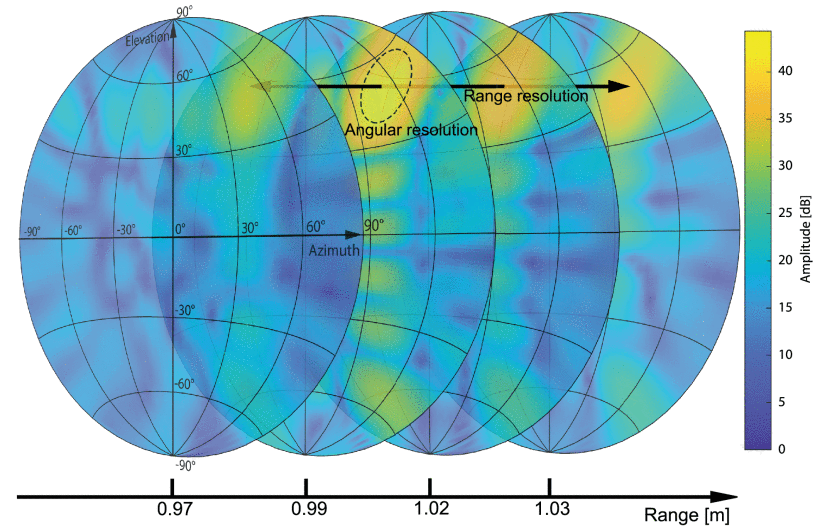
In-air acoustic imaging offers dependable sensing where cameras may fail, yet standard beamforming produces images with high sidelobes and limited contrast. To address this, we adapted a technique from medical ultrasound: higher-order Delay-Multiply-and-Sum beamforming, which extends the dynamic range from roughly 40 dB to nearly 80 dB and suppresses noise and artifacts. Moreover, a mathematical shortcut keeps the computational cost linear, allowing the method to run on both embedded Jetson boards and desktop GPUs, with the optional contrast filter adding only about 1.6% processing time. The implementation is open source and was tested on a mobile robot.
Broadband MEMS Microphone Arrays with Reduced Aperture Through 3D-Printed Waveguides
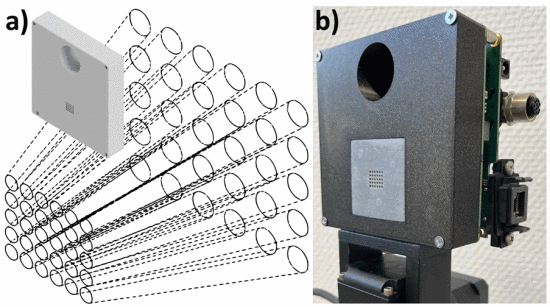
MEMS microphones are compact and affordable, yet their physical size limits how closely they can be spaced on a circuit board. As a result, beamforming above 45 kHz suffers from grating lobes, false directions that cause ghost detections. To overcome this, we added a 3D-printed baffle with 30 waveguides that narrows the effective spacing from 3.8 mm to 1.8 mm, raising the usable limit to 95 kHz. Once calibrated for the delays the waveguides introduce, measurements closely match simulations. The approach also opens the door to mimicking how bats hear.
EchoPT : a pretrained transformer architecture that predicts 2D in-air sonar images for mobile robotics

Robots that navigate with ultrasound often face noisy, incomplete data. To address this, we developed EchoPT, a transformer that predicts the next sonar image from recent frames and the robot’s planned movements. Because it trains itself on raw sonar data, much like a large language model, it requires neither labelled data nor extra sensors. In simulation, its predictions proved far more accurate than the baselines, reaching a 0.97 correlation with the true next image, against 0.86 for the best baseline. Furthermore, when noise overwhelmed the sensor for about 30% of a run, the predictions kept the robot on course.
Hardware-Accelerated Geometrical Simulation of Biological and Engineered In-Air Ultrasonic Systems
Studying bat echolocation and developing ultrasonic sensors both require realistic test environments, yet existing simulators struggle with the high frequencies, large scenes and moving objects involved. To overcome this, we built SonoTraceUE, an Unreal Engine plugin that uses GPU ray tracing to simulate how sound travels through detailed 3D worlds. As a result, researchers can recreate a bat hunting a scorpion or test robot navigation entirely in simulation. Moreover, the simulation reproduces the spatial patterns of real recordings and struggles in the same places as a real sensor. The framework is open source.
High-density MIMO localization using a 32×64 ultrasonic transducer-microphone array with real-time data streaming
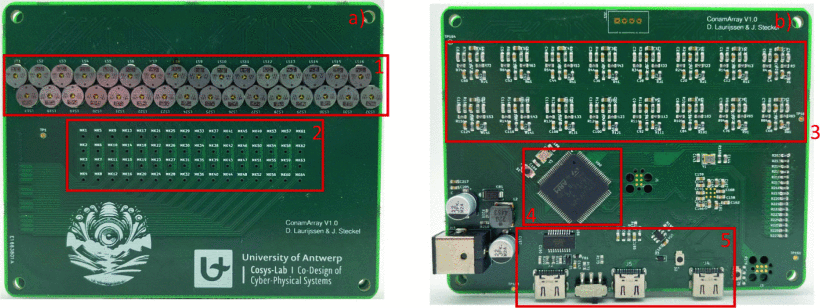
Conventional ultrasonic localization relies on a single emitter and a small array, which limits spatial resolution and robustness in echo-rich environments. To overcome this, we built ConamArray, a compact MIMO platform (102 × 80 mm) combining 32 transmitters with 64 MEMS microphones. Each transmitter sends its own random-phase signal, so the receiver can tell their echoes apart. Consequently, simulations show clearly better separation of reflectors and a 30 dB stronger image than with a single emitter. Moreover, the hardware already streams live data from 16 microphones, with real-time beamforming as the next step.